

JET Programme 2027 — Teach English in Japan
With its rich history and unique blend of traditional and modern culture, teaching English in Japan provides opportunities to work in diverse settings, from bustling cities to tranquil rural towns.
Japan has long been a top destination for English teachers worldwide. The country’s commitment to improving English language education, coupled with the opportunity to immerse oneself in local communities and gain a deeper understanding of Japan’s vibrant culture, makes it an appealing choice for ESL teachers.
So, how do you get started with teaching English in Japan? Let’s take a look at some of the pathways available and how you can make the most of this exciting opportunity.
How to get started teaching English in Japan
If you’ve decided that you wish to start teaching English in Japan, then where do you start?
The two most common ways are:
- Having a company sponsor you with a work visa and permit.
- Apply and teach through the government-run JET Programme.
The first way is pretty straightforward. You first find a Japanese company that is willing to hire and sponsor your work permit and visa. They will then help you apply for all the required documents. Once everything is completed, you travel to Japan and start teaching.
This is of course a quite simplified version of the required steps. But it’s also the most common way to start teaching English in Japan. One thing that may be of concern if you are just starting out, is that you will have to take responsibility for a lot of the steps in the process.
This can be things such as finding accommodation, setting up bank accounts, learning how to file taxes, etc.
The only real support net you have to help you with things like this is the contracting company and the Japanese Embassy in your country. As you can probably tell, this might sound a little bit overwhelming if you are just starting out.
This brings us to the alternative way of getting started, which is teaching via the JET Programme.
Image courtesy of the JET Programme.
What is the JET Programme?
The Japan Exchange and Teaching (JET) Programme was launched in 1987 as an international exchange program with the purpose of promoting internationalisation in Japanese local communities by helping to improve foreign language education. It aims to create grassroots-level cultural exchange between Japan and participating nations.
It is administered by the Japanese government, and it is currently one of the largest international exchange programs in the world. Through the JET program, the Japanese government invites young college graduates from all over the world to participate in internationalisation initiatives and language education in local Japanese schools and organisations.
Teaching positions
When applying to the JET Programme, you are able to apply for three different types of positions:

Participants that are employed as ALTs will be placed in schools or local boards of education. Their main job is to assist Japanese Teachers of English/Language (JTE/JTL) with foreign language lessons, help prepare teaching materials and be involved in extracurricular activities such as English clubs.
However, ALTs are not limited to only teaching English. In fact, over the years, the JET Programme has welcomed ALTs to teach other languages such as Chinese, Korean, French, Russian, and others. Some participants from non-English-speaking countries also serve as English-language ALTs, often bringing multilingual capabilities to their roles.
More than 90% of JET participants are ALTs.
Common ALT duties are:
- Assistance in foreign language and other instruction in elementary, junior high, and senior high schools.
- Assistance in foreign language and other related activities in elementary schools.
- Assistance in preparation of foreign language teaching materials.
- Assistance in foreign language training for teachers and other personnel.
- Cooperation in extracurricular activities and club activities.
- Provision of linguistic information (e.g., word usage, pronunciation, etc.) to foreign language instruction supervisors and teachers, among others.
- Cooperation in foreign language speech contests.
- Cooperation in local international exchange activities.
- Other duties as deemed necessary by the supervisor or school principal.

Participants that are employed as CIRs will assist local government organisations in various international exchange activities. The requirements to work as a CIR are a little bit higher, as you are required to have a functional command of the Japanese language (equivalent to N2 or higher on the Japanese Language Proficiency Test).
CIRs can also teach English. The work duties for each CIR can differ a lot as they are related to the international activities carried out by the contracting organisation.
Common CIR duties may include:
- Assistance in international exchange affairs at the contracting organisation (e.g., editing, translating, and compiling publications into a foreign language; cooperating or advising on the planning, design, and implementation of international exchange projects; hosting official guests from abroad; interpreting at various events, etc.).
- Assistance in international economic exchange affairs at the contracting organisation (e.g., cooperation or advising on the planning, design, and implementation of international economic exchange projects, such as expanding the overseas market for local products, attracting foreign tourists to Japanese localities, etc.)
- Cooperation in language instruction of employees of the contracting organisation and local residents.
- Advising and collaborating on projects with local private groups or organisations engaging in international exchange.
- Cooperation in cultural exchange activities (including school visits) for improving local residents’ cross-cultural awareness and understanding, and in activities to support foreign residents in Japan.
- Other duties as deemed necessary by the supervisor.

Participants that are employed as SEAs will work for local governments where they coach and promote internationalisation through sports. Their role is to assist with sports training and the planning of sports related projects. SEAs are sports professionals that bring exceptional expertise to their roles, and they are often backed by impressive careers in competitive sports.
To be selected as a SEA, candidates must be recognized as outstanding coaches in their sport and receive official recommendations from their home country’s National Olympic Committee or relevant government agency.
Common SEA duties may include:
- Assistance in sports instruction-related affairs at the contracting organisation (e.g., cooperating or advising on the planning, design, and implementation of sports projects).
- Cooperation in sports training for promising local athletes.
- Cooperation in sports training for employees of the contracting organisation and local residents.
- Advising and collaborating on sports projects of local private groups or organisations engaging in international exchange.
- Other duties as deemed necessary by the supervisor.

Benefits of teaching English via the JET Programme
Launching your English teaching career in Japan with the JET Programme is a great way to get a smooth start, as you will be given a lot of benefits and support throughout the whole process.
As the JET Programme is a government-sponsored programme, and not a business or language school, the goal of the programme is not profit-oriented. Instead, the focus is on promoting internationalisation in Japan’s local communities by helping them improve foreign language education and promoting international exchange at the community level.
This helps ensure that you will be well taken care of when teaching via the JET Programme.
Here are some of the perks of teaching via JET:
- Remuneration: JET Programme participants receive a remuneration of approximately 4.02 million yen for their first year of appointment. Remuneration increases with subsequent appointments.
- Holidays: Saturday, Sunday, Japanese national holidays, paid leave (at least 10 days). Due to work circumstances, JET Programme participants may be asked to work during weekends and national holidays.
- Work Hours: 35 hours per week, standard (typically Monday to Friday)
- Insurance: All JET Programme participants are covered with four types of insurance:
- Mutual Aid Association of Prefectural Government Personnel/Japan Mutual Aid Association of Public School Teachers/Private School Mutual Aid — Equivalent to Health Insurance (compulsory)
- Pension Insurance (compulsory)
- Employment Insurance (compulsory)
- JET Programme Accident Insurance (private insurance for JET Programme participants only)
- Japanese courses: JET participants have access to free Japanese language courses online to help them improve their Japanese capabilities and knowledge about Japanese culture.
- Teacher training: ALTs have access to the Basic Online ALT Training System (BOATS) to help them acclimate to and thrive in their roles in the Japanese educational system
- Counselling: Access to free online counselling services and partially subsidized (50%, up to ¥30,000 per year) counselling with mental health professionals in Japan or abroad not covered by health insurance.
- Career support: Career fairs in Tokyo and Osaka, internships, lectures, and networking events are available for all JET Programme participants and alumni in order to support their post-JET careers.
More specific details will be provided during the application process.

Who can teach via the JET Programme?
General criteria
In order to be eligible for teaching English through the JET Programme, you must:
- Hold a Bachelor’s degree or higher, or obtain such qualifications by the designated arrival date (applicants for the ALT position may alternatively hold a certification of completion of a 3 (or more) year course to teach at primary/elementary or secondary schools or obtain such qualification(s) by the designated arrival date).
- Be a national (not just a permanent resident) of the country where the recruitment and selection procedures take place by the time you submit your application form. Furthermore, those who possess Japanese citizenship must have submitted their applications to renounce their Japanese nationality before the Reply Form submission deadline. Applicants who possess multiple nationalities with countries other than Japan may only apply as a national of one of those countries.
- Not have lived in Japan for 6 or more consecutive years in total since 2016 by the time you submit your application form.
- Not have participated on the Programme since the 2023 JET Programme year (inclusive of March 2023 Arrivals) or have participated on the Programme for more than 6 years in total.
- Not have declined a position on the Programme after receiving notification of assignment in the previous JET Programme year (excluding cases where it is accepted that the Participant had a valid, inevitable reason for withdrawal).
- Be adept in contemporary standard pronunciation, rhythm, and intonation in the designated language and possess excellent language ability that can be applied accurately and appropriately, as well as have the ability to form sentences in a comprehensive and logical manner.
- Be interested in Japan and be willing to deepen your knowledge and appreciation of Japan after their arrival. Be motivated to participate in and initiate international exchange activities in the local community. Make efforts to study or continue studying the Japanese language prior to and after arriving in Japan.
- Be willing and able to adapt to living and working in Japan, and commit to responsibly fulfilling your job duties for the duration of their period of participation.
- Be mentally and physically healthy.
- Have a desire to proactively maintain relations with Japan, even after completion of the Programme.
- Agree to reside in Japan under the status of residence stipulated in Article 2-2 of the Immigration Control and Refugee Recognition Act. However, this does not apply to special permanent residents as defined in Article 3 of the Special Act on the Immigration Control of, inter alia, those who have lost Japanese Nationality pursuant to the Treaty of Peace with Japan.
- Be willing to obey all Japanese laws.
- Not possess a record of crimes which would render you inappropriate for participation in the Programme (e.g., DUI (driving under the influence of alcohol and/or drugs), narcotics and other drug-related offenses, sexual offenses, crimes involving children, etc).
- Applicants with a suspended jail term must have finished their period of probation by the time they submit their application form.
Additional criteria for ALT applicants
In addition to the above general criteria, ALT applicants must:
- A demonstrated interest in the Japanese education system, particularly foreign language education.
- A willingness to work proactively with children.
- Qualifications as a language teacher or a strong enthusiasm for language education.
Meriting qualifications
The following qualifications are not part of the official eligibility criteria, but they will give additional consideration to applicants who:
- Have language teaching experience or qualifications (e.g. TESOL/TEFL certificates).
- Have general teaching experience or qualifications.
- Have a high level of Japanese language ability.
CIR applicants must:
- Have a functional command of the Japanese language (equivalent to N1 or N2 level of the Japanese Language Proficiency Test).
⚠️Note: In the case of English-speaking countries (United States, United Kingdom, Australia, New Zealand, Canada, Ireland, South Africa, Singapore, Jamaica, Barbados, Trinidad and Tobago, Philippines, India, etc.) the designated language is English.
For France, it is French, for Germany it is German, for China it is Chinese, for Korea it is Korean, and for other non-English speaking countries, it is the principal language spoken in that country. However, there may be cases where English is required as well.
Applicants from non-English speaking countries must have a functional command of the English or Japanese language.
Visit the official website or contact your local Japanese Embassy/Consulate for more information about the full eligibility criteria.
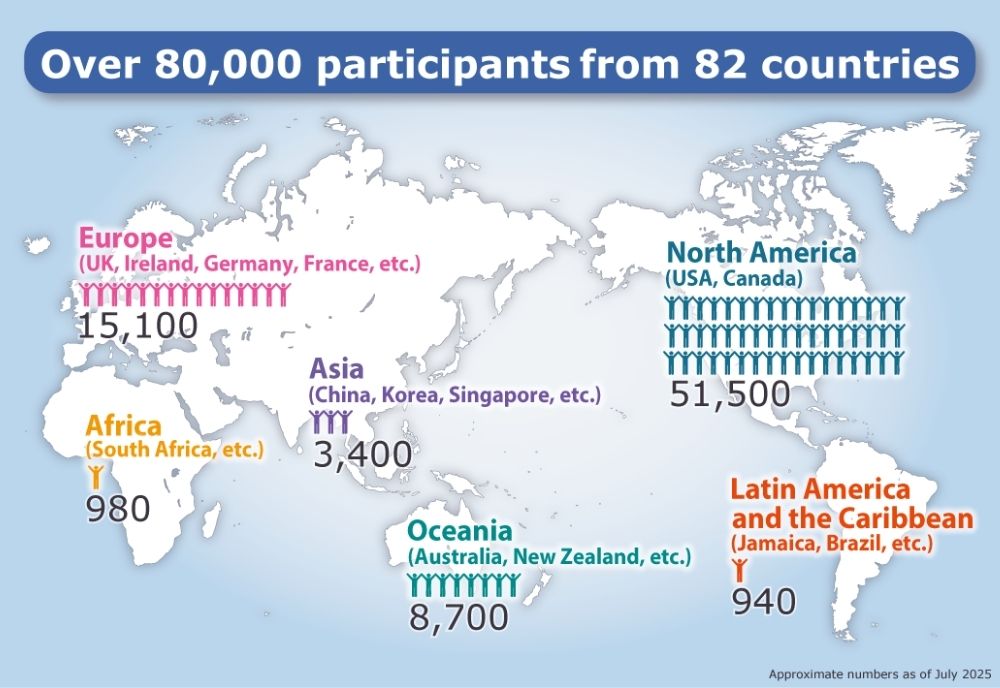
Image courtesy of the JET Programme.
Participating countries
Since the beginning of the JET Programme, they have seen significant growth, from its original 848 participants from 4 countries in 1987, to 5,734 participants from 53 countries in 2026. In total, they have had more than 82,000 participants from 82 countries join the programme since its inception.
The JET Programme is now welcoming participants from 53 countries for the 2026-2027 year.
To see which countries are participating in the JET Programme for the 2027 intake, please visit the official website or contact your nearest Japanese Embassy/Consulate.
⚠️ Citizens of non-participating countries and some specific participating countries can only apply to the JET Programme if a local government in Japan has specifically requested a participant from that country.
Can non-native speakers participate?
Whether or not a non-native speaker is eligible to participate in teaching English via JET, depends on the individual person’s situation and qualifications. Please reach out to the Embassy or Consulate General of Japan in your country of citizenship to see if they have any JET Programme positions available.
Do you need a TESOL/TEFL certificate?
While an English teaching certificate such as a TESOL/TEFL certificate is not an official requirement for participating in the JET Programme, having such certifications will be an asset during the selection process.
Do you need teaching experience?
No teaching experience is needed for participating in the JET Programme. However, just like with the teaching certificates, having prior teaching experience will be an asset during the selection process.
Is there an age limit?
There is no age limit as long as applicants meet all other eligibility criteria. Applicants will also be judged on maturity, professionalism, and ability to adjust to other cultures.
Getting your TESOL/TEFL certificate: Improve your chances of being accepted into the competitive JET Programme by becoming TESOL/TEFL certified.
If you haven’t earned your accredited 120-hour TESOL/TEFL certificate yet, you can enroll in the course here:
.

Where can you teach with the JET programme?
JET Programme participants are appointed to teaching positions in local government organisations and schools by the participating prefectures and municipalities throughout Japan.
Your specific work activities are needs-based, and they are independently decided by the prefectural governor or city/town mayor. Although the organisations involved in the JET Programme are primarily local government authorities, JET Programme participants may also be placed in private schools when there is a request.
Placement requests are sometimes possible, but not guaranteed.
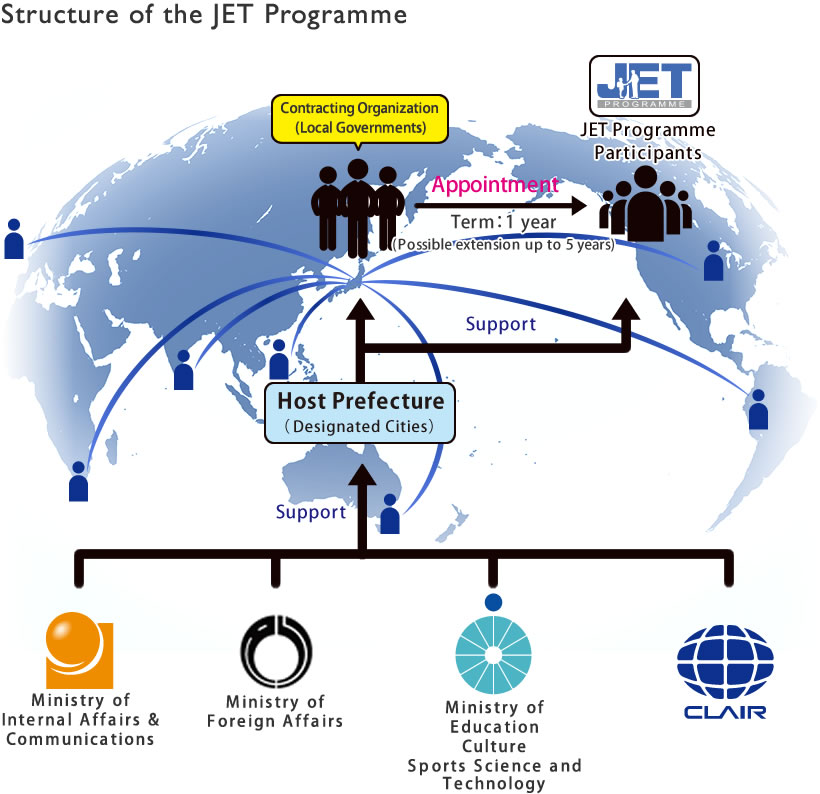
There are currently approximately 1,000 local government organisations, across 46 prefectures and 17 designated cities which host JET Programme participants.
Visit their website to learn more about the structure of the JET Programme.
When does the JET Programme start?
The recruitment, application, and selection process for new JET participants is conducted by the Japanese Ministry of Foreign Affairs through its embassies and consulates in participating countries.
Application start and deadline:
Applications for the JET Programme generally open in early fall (around September or October). However, since the application process is managed individually by each Japanese Embassy and Consulate, the start date may vary between countries.
To confirm the application start and deadline, please contact the Embassy or Consulate General of Japan in your country of citizenship.
JET Programme start:
When a candidate has been accepted and received a placement, they are expected to arrive in Japan during spring or summer before the semester starts.
How long can you teach via the JET Programme?
If you get accepted into the JET Programme, you are required to teach for 1 year. There is a possibility to extend your contract if both you and the contracting organisation are in agreement. This can be done twice, meaning that you can teach via the JET Programme for a total of 3 years.
💡 If a JET participant’s work performance is deemed to be of an exceptionally high standard, they may be able to get reappointed an additional two more times, extending it to a maximum total of 5 years on the JET Programme.
How do you apply?
To apply for the JET Programme as an Assistant Language Teacher (ALT), you need to reach out to the Japanese Embassy or Consulate in your country of citizenship to see if they are accepting applications.
Please visit JET’s website to see the participating countries for the 2027 intake.
It’s worth noting that the application process for the JET Programme is quite demanding and can take several months. Applicants should also give serious thought to whether they are prepared to commit to living and working in Japan for at least one year.
However, if that’s not an issue, and you are able to successfully obtain a spot, the benefits are well worth all the effort.
Further reading
For more information about the JET Programme, please visit the official JET Programme website or contact the nearest Japanese Embassy or Consulate in your home country.
To help you get started with your application, we also recommend taking a look at the following materials:
Best of luck with your application!


Leave A Comment